How will we do it? Student competitions will fuel the autonomous robotics workforce.
GUEST COLUMN | by Sebastian Castro
Autonomous industrial robots
are the way of the future. The International Federation of Robotics
expects the number of industrial robots deployed worldwide to increase
to around 2.6 million by 2019—about one million units more than in the record-breaking year of 2015.
In
the face of such growth, the stationary industrial robots of today will
eventually be replaced by more versatile mobile manipulation systems –
that is, robots that are able to grasp objects as well as move around an
industrial space
It
can be challenging for industry to dedicate the resources required to
support the research and development of emerging technologies that
enable full autonomy.
Student
competitions, such as RoboCupIndustrial, are offering a solution by
accelerating research and development of autonomous industrial robots
with technologies like motion planning, computer vision, and machine
learning.
The
competition, with support from corporate sponsors, provides a test
center for students to gain experience with real-world hardware and
software design tools as they build their autonomous industrial robots.
The
insights the participants’ research uncovers can then be leveraged by
industry and help further the development of a commercially available
autonomous workforce.
Accelerating Research and Development of Emerging Technologies
In
the RoboCupIndustrial competition, students design autonomous robots
that can perceive their environment and provide increased input and
output with superhuman consistency while accomplishing more diverse
tasks—tasks the prior generation of stationary robots could not
accomplish.
Student
teams in RoboCupIndustrial are typically supported by research labs or
companies, and their competition work has the potential of becoming
trendsetting technology that can influence how commercial products are
designed.
The
students are at the forefront of integrating emerging technologies such
as deep learning and reinforcement learning into their designs,
enabling the robots to “learn” on the job. Two competitions under the
RoboCupIndustrial umbrella, RoboCup@Work and RoboCup Logistics League,
illustrate how student competitors are driving the research and
development of a potentially fully autonomous workforce by designing
intelligent robots.
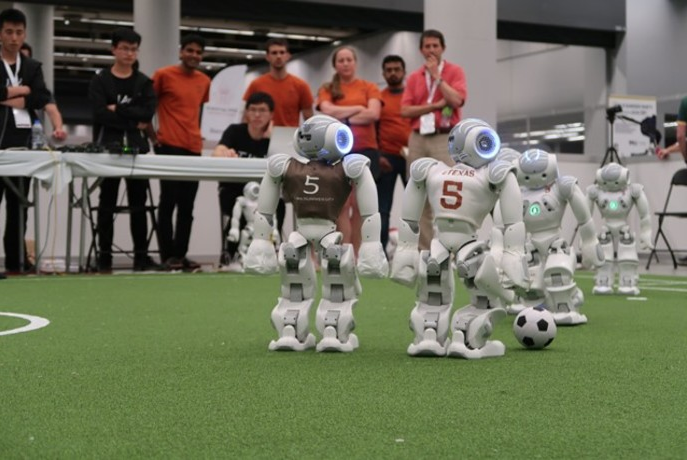 During
RoboCup@Work, students design robots that can navigate their
environment and perform tasks that mimic an actual assembly or factory
process. These fully mobile robots can manipulate objects and perform
complicated functions like transporting materials, picking materials off
conveyor belts, and handling precision parts placement.
During
RoboCup@Work, students design robots that can navigate their
environment and perform tasks that mimic an actual assembly or factory
process. These fully mobile robots can manipulate objects and perform
complicated functions like transporting materials, picking materials off
conveyor belts, and handling precision parts placement.
RoboCup
Logistics League challenges competitors to synchronize multiple
autonomous robots by enabling them to communicate with each other and
choreograph tasks to achieve common goals like packing boxes or
processing orders.
Industry and Competition Collaboration
Because
industry benefits from these competitions, companies are increasingly
providing students with support to accelerate their research efforts.
RoboCupIndustrial sponsors, such as MathWorks, provide students with
real-world hardware and software tools, like MATLAB,
and technical expertise, which helps simplify complex concepts and
limits the amount of time spent on basic coding. Access to such tools
also allows competition teams to spend more time implementing their
algorithms and writing papers or developing new approaches to robotics
design.
Companies
benefit by receiving feedback on their tools and getting insights into
how students use them in their robot designs. These insights can be
leveraged across the company, shared with other research organizations,
and incorporated into their product development workflows.
The
collaboration between student competitions and industry is driving the
research of commercially viable, fully autonomous industrial robots.
Student teams and the insights they provide to sponsoring companies
further robotics product development efforts and move us closer to
robots that provide practical commercial applications. Such partnerships
are opening a path to a more fully autonomous robotics future.
—
Sebastian Castro is a multidisciplinary robotics engineer with a passion for education and lifelong learning. He is an education evangelist at MathWorks,
preparing and supporting next generation scientists and engineers with
software, training, and mentoring to tackle the same technical issues as
professional engineers. His interests include modeling and simulation,
control systems, computer vision, AI, and software development. Contact
him through LinkedIn.