Why all schools should integrate a virtual coding and robotics platform into their learning environments.
GUEST COLUMN | by Paul Keeney

Internationally, robotics and
coding are becoming required curriculums for middle and high school
students, yet the U.S. remains behind schedule in this area. Where many
other countries are infusing coding, robotics, and computational
thinking into their curriculums, a lot of schools here are stuck in
somewhat of a technology inertia as they look for ways to catch up.
‘Middle school students like action, and they like things to have a purpose.’
Here are six key reasons why I see virtual coding and robotics programs becoming a mainstay in our nation’s schools:
1. Virtual robots are just as “real” as their physical counterparts.
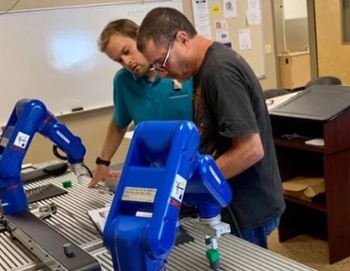
One day I opened up the cabinet full of robots and told my class,
“There’s $8,000 worth of robots in here, but we can’t use them because
the school district is not letting us share equipment this year.” I then
asked my hybrid schedule students to look at the robot on their
computer screens, and they noticed right away that it was the same robot
design.
So, where our
revamped robotics course may be fully online, it’s based on real-world
applications that students can relate to and engage with in a blended
learning model. Also, because I understand the LEGO EV3 programming (that’s what I normally teach in my class), the transition to using the CoderZ STEM curriculum was very easy.

2. Virtual robotics helps students develop new skills.
Physical robots often lead kids to focus more on design and less of the
coding, science, and math skills that drive the virtual robots.
3. They support equity in education.
Virtual robotics promote equity because every student in a district can
get access to the platform—not just those that attend a school with a
robotics platform, or that can afford an after-school club or elective.
4. Kids can work at their own pace.
Our Computer Science/STEM curriculum provides the perfect solution for a
self-paced, flipped, or blended classroom where kids can use the same
skills that they would even if they were using real robots. Only now
there’s no hardware to worry about; it’s all online. Knowing this, I’ve
also suggested our STEM platform to other teachers who teach technology
education at other schools in our district.
‘This is helpful as I pivot between in-class, distance, and hybrid learning…’
5. Students love it. Our
robotics platform is engaging for students and includes a lot of
different gamification qualities. Middle school students like action,
and they like things to have a purpose. Because the STEM platform is
basically an obstacle course-based set of challenges, most of them jump
onto that and want to do well and get it right.
And
when they don’t get it right, those students are anxious to keep
improving until they do, versus seeing the coding work as an assignment
or a chore. The curriculum is instructional, but not so much so that
students get bored with it.

6. Teachers can easily track student progress and understanding.
I use the built-in scoring within the platform to track student
progress, and track the red, yellow, and green lights for every
activity. I assign points based on the completed activities and level of
comprehension. This is helpful as I pivot between in-class, distance,
and hybrid learning, as I end up spending entirely too much time writing
new activities and adjusting my current lesson plans.
This,
in turn, impacts how I manage my grading system. With our STEM program,
I can quickly review all of the progress made on mini-lessons, and
detect potential problems (i.e., not many “dots” filled in means not a
lot of work was completed).
It’s a No-Brainer
If
your school is trying to come up with something that you can teach in
any learning model – distance learning or in-person or a mix of both,
this coding and robotics platform is a no-brainer because it’s
structured well, engages students at a high level, and is
teacher-friendly. In fact, even a teacher without a strong background in
robotics or coding can pick the curriculum up and start using it on day
one. In return, students learn the future-ready career skills that
employers are looking for via a fun software package that’s easy to
manage and teach.
—
Paul
Keeney is technology education and engineering instructor at Oak View
Middle School in Andover, Minn. Connect with him here: school website.