Saturday, March 22, 2008

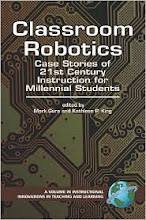
Classroom Robotics (the book)

Classroom Robotics
Case Stories of 21st Century Instruction for Millennial Students

Edited by: Mark Gura, Fordham University and
Kathleen P. King, Fordham University 2007
A volume in the series: Instructional Innovations in Teaching and Learning.
Series Editor(s): Kathleen P. King, Fordham University and Mark Gura, Fordham University

ORDER ONLINE
http://www.transformationed.com/
Paperback $39.99ISBN: 978-1-59311-839-6T
Hardcover $73.99ISBN: 978-1-59311-659-0
ORDER DIRECT from AUTHOR
Transformationed@gmail.com
10% discount and autographed by King and Gura if requested

Hallmarks of Classroom Robotics
· Chapters written by current and former NYS teachers
· Case stories, practice means theory, curricular suggestions
· Application of robotics across content areas
· Based on our work that brought student robotics practice competitions to the Bronx
· Adopted as textbook at teacher education colleges in New York state
· Already available in 46 libraries around the world (CA, NY, WY, TX, IA, PA, MA, VA, GA, AL, Singapore, Australia, New Zealand, Hong Kong, Canada and many more)


CONTENTS: Dedication. Preface, Kathleen P. King. PART I: CLASSROOM ROBOTICS BASICS. What is Student Robotics? Mark Gura. Student Robotics: A Model for 21st Century Learning, Mark Gura. PART II: CASE STORIES. Not Your Average "Soccer Mom." Carol Franken. Changing the Inner City, One Robot at a Time, Evan Weinberg. PB&J, Robotics, and Programming, Agata Dean. Teaching, Coaching, and Parenting RoboCup Jr., Laura Allen. From LOGO to LEGO Robotics? A Journey, Phil Firsenbaum. The Morris High School Robotics Team: An Interview: Winners at a High-Intensity Sport for the Mind, Mark Gura. Power of Robotics in the Lives and Learning of Alternative High School Students, Albert Robinson, Kathleen P. King, and Ryan Thompson. Bringing Robotics to Life: Students Experience Life Sciences with Real World Medical Applications, Joselyn J. Todd and Eric Himburg. PART III: PERSPECTIVES ON ROBOTICS AND LEARNING. Robotics-Prime Opportunities for Careers and Student Learning, Kathleen P. King. Learning and Literacy in Robots-Making Connection for the Classroom, Steven D'Agustino. Catching the Vision, Teachers as Learners: Robotics Professional Development, Steven D'Agustino and Kathleen P. King. PART IV: RESOURCES AND CONCLUSION. Student and Classroom Robotics Equipment: Robotics Kits, Components and Material, Mark Gura. Information Resources for Student and Classroom Robotics: Web Sites, Magazines and Resources, Mark Gura. Program and Curriculum Resources for Student and Classroom Robotics: Organizations, Software and Curriculum, Mark Gura. Conclusion and Beginnings, Kathleen P. King. About the Authors. Index.

Tuesday, March 11, 2008

Robots to now perform surgery on youngsters!

From: Khaleez Times online

Robotics surgery for children discussed

"ABU DHABI — Robotics surgery for children was debated yesterday by an elite panel of international experts attending the UAE Paediatric Surgeons Conference, first of its kind to be hosted by Abu Dhabi.


The three-day conference themed 'Kids' Safety in the UAE and the Arab World' has been organised by the Medical Services Department in the UAE Armed Forces, in cooperation with the Emirates Medical Association (EMA) and the Arab Association of Paediatric Surgeons.

Delicate surgeries for children will take place at Shaikh Zayed Military Hospital on the sidelines of the conference and will be transmitted live so as to enable international experts from France and other European countries to take part in the operations.

About 80 scientific research papers pertaining to child health and seven sessions will be dedicated to shed light on minimal invasive surgery and robotics surgery, in addition to child abuse, safety and trauma. Participants will be accredited 21 hours of Continued Medical Education (CME) certificate by the American CME Academy.

The participants will discuss a proposal to initiate an annual award named 'Shaikh Zayed Award' for the best Arab paediatric surgeon. A project to set up the first Gulf association of paediatric surgeons, will also be discussed during the conference."

Read article at its source:
http://www.khaleejtimes.com/DisplayArticleNew.asp?xfile=data/theuae/2008/March/theuae_March240.xml&section=theuae&col=

Tuesday, March 4, 2008

Warrior Robots? Let's Be Careful What We Wish for...

From: The Star
Sheffield expert claims risk from warrior robots
"TERMINATOR-style robot warriors could soon be stalking the earth as a result of a new automated arms race, according to a Sheffield University boffin.
Professor Noel Sharkey, well known for his appearances on hit TV shows Robot Wars, believes the new generation of weapons being developed around the world pose a real threat to humanity.The robotics expert told the Royal United Services Institute he believed it would not be long before robots became a terrorist weapon to replace the suicide bomber.Many nations are now involved in developing the technology for robot weapons, with the US Department of Defence being the most significant player.According to expert journals the US proposes to spend an estimated $4 billion by 2010 on unmanned systems technology. The total spending is expected to rise above $24 billion.Prof Sharkey said: "The trouble is we can't put the genie back in the bottle. Once the new weapons are out there, they will be fairly easy to copy. How long is it going to be before terrorists get in on the act?"With the prices of robot construction falling dramatically and the availability of ready-made components for the amateur market, it wouldn't require a lot of skill to make autonomous robot weapons."
Read the full article at its source:
http://www.thestar.co.uk/news/Sheffield-expert-claims-risk-from.3833613.jp

The EMOTIONAL Bond Between Robot and Human DEEPENS!

From: ABCnews
Japan Looks to a Robot Future
Far Ahead of Other Countries, Japan Experiments With Robots As Part of Daily Life
"At a university lab in a Tokyo suburb, engineering students are wiring a rubbery robot face to simulate six basic expressions: anger, fear, sadness, happiness, surprise and disgust.

Hooked up to a database of words clustered by association, the robot — dubbed Kansei, or "sensibility" — responds to the word "war" by quivering in what looks like disgust and fear. It hears "love," and its pink lips smile.
"To live among people, robots need to handle complex social tasks," said project leader Junichi Takeno of Meiji University. "Robots will need to work with emotions, to understand and eventually feel them.
While robots are a long way from matching human emotional complexity, the country is perhaps the closest to a future — once the stuff of science fiction — where humans and intelligent robots routinely live side by side and interact socially.
Robots are already taken for granted in Japanese factories, so much so that they are sometimes welcomed on their first day at work with Shinto religious ceremonies. Robots make sushi. Robots plant rice and tend paddies.
There are robots serving as receptionists, vacuuming office corridors, spoon-feeding the elderly. They serve tea, greet company guests and chatter away at public technology displays. Now startups are marching out robotic home helpers...:
Read the full article at its source:
http://abcnews.go.com/Technology/GadgetGuide/wireStory?id=4370051

Wednesday, February 27, 2008

Internal Robotics?

From: WIRED
... Microbots' Fantastic Voyage Through Your Clogged Arteries
"Finally, Fantastic Voyage is becoming reality — well, almost. Rather than mini Raquel Welches scuba diving through your veins, picture teeny-tiny insects. Researchers at the Korea Institute of Science and Technology are building six-legged robots small enough to skitter through your blood vessels. The critters can crawl for up to 10 days, no batteries required. Their biocompatible skeletons — made of the same stretchy stuff that's in Silly Putty — are plated with heart cells from rats. When immersed in a glucose solution, the cells beat in synchrony. With each pulse, the bot's back legs contract, pushing the bug forward at a "speed" of 100 micrometers per second (50 meters a week). Lead scientist Sukho Park believes such devices could be injected into humans to treat cardiovascular disease as early as 2020. Once inside a clogged vessel, the bot would feed off the glucose in the blood as it creeps along the length of the artery, releasing a dissolving agent to clear blockages and plaque. Sure, but how will it look in a formfitting wet suit?"
Read the article at its source:
http://www.wired.com/medtech/health/magazine/16-03/st_wtf#

Robot Invasion Begins: World on Brink of Immersion Into Robotically Enhanced Environment


From: TimesUnion.com
Artificial or not, AI enhances human life
"Self-steering vacuum cleaners. Self-parking cars. Dolls responding to voice commands.
We may not be living in the world of "The Jetsons," but robots are definitely becoming a part of ordinary life. The company iRobot reports that more than 2.5 million of its home robotic products -- Roomba vacuums, Scooba floor washers, Verro swimming pool scrubbers, Looj gutter cleaners and ConnectR "Virtual Visiting Robots" -- have been sold.

This year's Toy Fair introduced an animatronic "Elmo Live" that can act out stories. And Playskool's Kota the Triceratops, a $300 life-size baby dinosaur for preschoolers, reacts to touch by moving its head, tail and horns, and gives "a friendly dino roar" when spoken to.
Then there's the first-generation Lexus LS 460 L automobile with "Advanced Parking Guidance System," which parallel-parks itself (as long as there's 6 feet of wiggle room). The LawnBott LB3500 from KA Home Robotics can be told when and where to mow from your cellphone or PDA.

In fact, the line between appliance and artificial intelligence is getting blurrier every day. According to roboticist Daniel H. Wilson, author of "How to Build a Robot Army: Tips on Defending Planet Earth Against Alien Invaders, Ninjas, and Zombies" (Bloomsbury; 176 pages; $13.95), to be classified as a robot, a machine only has have the ability to sense the environment, "think" about what to do and act in the physical world. Doing it for you

That sense-think-act closed-loop process "is a pretty broad definition," Wilson admitted in a recent phone interview. "But we are surrounded by all these machines that are making decisions without human intervention. Robots don't have to move to be robots. Instead of moving themselves, they can send commands to the real world."

By that criteria, even a smoke alarm is a type of AI -- artificial intelligence. So are your car's antilock brakes: Hit the pedal to tell the ABS system you want to slow down, and the vehicle's onboard computer takes over and does it for you. No more relying on humans to resist the urge to slam on the brakes instead of using the more effective light taps.

"In How to Build a Robot Army," Wilson takes robots that can be found today in homes or in laboratories -- "A lot of them are prototypes. I have a lot of friends that have cool projects." -- and suggests ways to turn them into allies in the fight against pop-culture villains such as zombies and great white sharks.

The tongue-in-check instructions include adding a can of gasoline to your Roomba to turn it into a roving land mine, or sending micro air drones, such as the remote-controlled FlyTech Dragonfly from Robosapien-maker Wowwee, with infrared navigational sensors added on to do overhead reconnaissance of werewolf-filled forests..."
Read Full Article @ Its Source:
http://www.timesunion.com/AspStories/story.asp?storyID=666132&TextPage=1
Also See (from Wired News Blog):
Book Review: How to Build a Robot Army
"A couple weeks ago my GeekTeen, John, age 15, asked if he could blog a review of roboticist Daniel Wilson's two books. We checked and found Wilson had just published a new volume -- which gave me a great excuse to interview him too! He says he's gotten a lot of positive response from parents and kids (including Wired.com's Chris Anderson, whose kids sent him drawings inspired by his previous book).
You can read my Times Union interview with Wilson for the next week.
And here's John's review:
You’ve all seen movies where aliens come to wreak havoc in cities or Godzilla terrorizes Tokyo,and the poor, weak humans have to fight them. But what if we had robots on our side? Almost nothing can stand up to those powerhouses (except other robots of course). But how to make an army of robots? You buy this book.
How to Build a Robot Army is written by Daniel H. Wilson, who has a degree in robotics and has written two books before this one. (How to Survive a Robot Uprising and Where’s my Jetpack?) In this book, he tells you how to build a make-shift army using Roombas, Furbys and other household robots. The first part of the book is a crash-course in robotics: how to modify them for battle, what types there are, how to put weapons on them, and more. It also explains how to upgrade humans for battle (such as suiting them with exo-skeletons or swallowing a pill infused with microbots). Next is a lesson in robot training, such as how to make a robot team and how to tame walker robots. The final section is a list of famous movie monsters (Godzilla, the Wolf Man, zombies etc.) and what robots you can send against them...."
Full article @: http://blog.wired.com/geekdad/2008/02/book-review-how.html