The pool-playing robot - another way for robots to defeat humans
from THE RIDICULANT
"In yet another small step towards the time when robots will be able to rise up and overthrow their human masters, scientists have taught a robot how to play pool.
'Deep Green' - named after Deep Blue, the chess-playing supercomputer that beat reigning world champion Garry Kasparov in 1997 - was created by Robotics & Computer Vision lab at Queen's University in Ontario, Canada, with the intention of it becoming good enough at shot-playing and game strategy that it can eventually beat a human..."
Read the full article at its source: http://theridiculant.metro.co.uk/2009/09/the-poolplaying-robot-another-way-for-robots-to-defeat-humans.html
Monday, September 21, 2009


Wednesday, September 16, 2009
ShpinMENSCH Goilemat
WATCH: The Israeli robot who wants to be Spider-Man from HAARETZ.com
Even before the movie franchise existed, Spider-Man was known for his ability to scale great heights by shooting webs with his wrists that attach to buildings and allow him to swing for kilometers from one to the next. Spider-Man's agility recently inspired students in the robotics department at Ben-Gurion University to create a robot that can move like the superhero. The robot's prototype, which recently took its first steps in a video posted on YouTube, is called Spiderbot... read the full article at its source: http://www.haaretz.com/hasen/spages/1114694.html
Even before the movie franchise existed, Spider-Man was known for his ability to scale great heights by shooting webs with his wrists that attach to buildings and allow him to swing for kilometers from one to the next. Spider-Man's agility recently inspired students in the robotics department at Ben-Gurion University to create a robot that can move like the superhero. The robot's prototype, which recently took its first steps in a video posted on YouTube, is called Spiderbot... read the full article at its source: http://www.haaretz.com/hasen/spages/1114694.html
Monday, December 22, 2008
Classroom Robotics Considered a Top STEM Resource for Teachers
 >>>>>>>>>>>>>>>Berkshire STEM Pipeline Resource Page:
>>>>>>>>>>>>>http://www.mcla.edu/pipeline/bp/newfile.php
From the Berkshire STEM Pipeline - a glowing review of Classroom Robotics (click on the link below for the full text of the review)
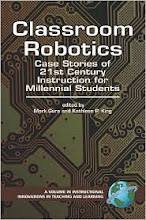
"Have you ever wanted more information about a particular subject? Were you able to find what you needed written in a book? Well, let me tell you that I just happened to pick a book titled, "Classroom Robotics Case Stories of 21st Century Instruction for Millennial Students", edited by Mark Gura and Kathleen P. King, as a last resort when I couldn't obtain one of my first three choices (always the case when you are looking for information on any topic, right?). I was in for a wonderful treat, which I hadn't expected, since I was still feeling quite glum at not getting one of my top picks on the subject of classroom robotics. My interest level in robotics increased when I attended a seminar at MCLA this fall, hence one of the reasons for my search for more on the topic. This book turned out to be just what I was looking for to help me understand many facets about classroom robotics which I had been intrigued with for some time. As the title suggested, I was expecting to read stories from teachers who had incorporated robotics in their classrooms. It was even more than just teachers' experiences! This was the wonderful treat! I had wanted to learn how to start robotics either in the classroom or as an after school program. Where did I start? How did I know which materials to choose? How does robotics fit into the fifth grade curriculum? I had so many questions- many of which were answered by reading this book. This book provided the best tool I could have hoped for as one of its main purposes was to reach out to people like myself just starting to explore the idea of classroom robotics..."
"Have you ever wanted more information about a particular subject? Were you able to find what you needed written in a book? Well, let me tell you that I just happened to pick a book titled, "Classroom Robotics Case Stories of 21st Century Instruction for Millennial Students", edited by Mark Gura and Kathleen P. King, as a last resort when I couldn't obtain one of my first three choices (always the case when you are looking for information on any topic, right?). I was in for a wonderful treat, which I hadn't expected, since I was still feeling quite glum at not getting one of my top picks on the subject of classroom robotics. My interest level in robotics increased when I attended a seminar at MCLA this fall, hence one of the reasons for my search for more on the topic. This book turned out to be just what I was looking for to help me understand many facets about classroom robotics which I had been intrigued with for some time. As the title suggested, I was expecting to read stories from teachers who had incorporated robotics in their classrooms. It was even more than just teachers' experiences! This was the wonderful treat! I had wanted to learn how to start robotics either in the classroom or as an after school program. Where did I start? How did I know which materials to choose? How does robotics fit into the fifth grade curriculum? I had so many questions- many of which were answered by reading this book. This book provided the best tool I could have hoped for as one of its main purposes was to reach out to people like myself just starting to explore the idea of classroom robotics..."
edited by Mark Gura and Kathleen P. King
reviewed by Paul Duhon, Lee Elementary School
Monday, December 1, 2008
Surgical Robots That Operate on You from the Inside
StomachBot: Magnetic Self-Assembly of Swallowable Modular Robots
Found @ http://www.sciencedaily.com/releases/2008/11/081129173859.htm:
"A Surgeon You Can Swallow"
"ScienceDaily (Dec. 1, 2008) — In the future, tablet-shaped robots could perform some surgical operations without injuring the body. A new publication by the Institute of Robotics and Intelligent Systems of ETH Zurich shows how such surgical bio-microrobots might function.
Paolo Dario, Professor of Biomedical Robotics at the Scuola Superiore Sant’Anna in Pisa, Italy, explained the dawn of a new medical era in the September edition of the American financial magazine “The Economist”. Surgical operations with open wounds are increasingly being replaced by non-invasive techniques extending even to systems that enable operations without a single scar.
Bio-microrobotics has a decisive role in this development. Like the Scuola Superiore Sant’Anna, ETH Zurich is also a part of the EU’s ARES research project (Assembling Reconfigurable Endoluminal Surgical System), a consortium of robotics experts from four European higher education institutions. Together, the researchers want to make micro-robots usable for medical applications. The plan is that, in the future, robots no bigger than a conventional capsule will perform a series of tasks in the gastro-intestinal tract, e.g. a gastroscopy or a tissue biopsy.
Although pill-shaped micro-cameras have existed for seven years now and are currently being used successfully in surgery to study the gastro-intestinal tract, these systems are passive. The camera takes thousands of pictures as it passes through the gastro-intestinal tract, but its position during this time cannot be controlled. This should soon change, because the ARES scientists are currently developing micro-robots with controllable insect-like legs with which the “robot pills” would be able to move around in the stomach. Other groups are working on special devices for tissue biopsy. In the future, such instruments could be used to make a precise examination of damaged regions in the gastro-intestinal tract while at the same time taking tissue samples for subsequent investigation.
Multi-segment, self-assembling stomach robots
One of the biggest challenges facing the robotics scientists relates to the enormous miniaturisation of the electronic systems. Room for the system’s entire technology, including the power supply, must be found within a few cubic millimetres. In the micro-cameras that are already established, the battery alone takes up 60 percent of the capsule’s volume. Hence one key question: how can a series of surgical robot functions be brought into a form that the patient can swallow and which is at the same time compatible with the body?
In a recent publication, Zoltan Nagy, a doctoral student at the Institute of Robotics and Intelligent Systems of ETH Zurich (IRIS) since 2006, presents the following approach to a solution: the patient swallows not one but several “robot pills” fitted with individual functions, such as the controller or forceps for tissue sampling. The pills can be swallowed one after another and assemble themselves automatically to form a larger, more powerful system only when they reach the stomach. For this purpose, Nagy developed a magnetic mechanism that enables the parts of the robot to join together automatically in the stomach to form an entire system. The individual components are polarized at right angles to the surface, so they arrange themselves in a predictable sequence when they come together.
The system was tested in an artificial stomach with a 75 percent success rate. Because a rigid chain of several robot components moves only with difficulty through the stomach and intestine, Nagy has also developed intermediate links that make the system more mobile. This would enable the surgical system to move as a whole through the stomach and intestine, like a multi-link chain. A magnetic system has the added advantage that the magnetic field changes in a characteristic way when the individual members of the chain come together. This change is measurable and can be communicated to a computer and used as an indicator of the exact position and arrangement of the robot snake.
Probing the limits of feasibility..."
Reach this article in its entirety at its source: http://www.sciencedaily.com/releases/2008/11/081129173859.htm
also read "Building a Self-Assembling Stomach-Bot" @ http://www.technologyreview.com/computing/21401/page2/
Tuesday, November 11, 2008
Open Wide!
 ..........................................From: thesouthern.com
"Robotics, orthodontics a winning combination"
"HERRIN - Patient satisfaction with orthodontic care has been enhanced greatly with the development of robotics. This new procedure, known as the SureSmile system, is being performed by only a handful of specialists in Illinois.Dr. Kyle R. Childers, who owns a practice at Logan Professional Park in Herrin, is one such specialist. He has spoken at seminars to inform fellow orthodontists and dentists of the technological advancement.
"HERRIN - Patient satisfaction with orthodontic care has been enhanced greatly with the development of robotics. This new procedure, known as the SureSmile system, is being performed by only a handful of specialists in Illinois.Dr. Kyle R. Childers, who owns a practice at Logan Professional Park in Herrin, is one such specialist. He has spoken at seminars to inform fellow orthodontists and dentists of the technological advancement.
Childers said that instead of eyeballing a wire and bending it for the patient's braces by hand, he is able to maneuver the wire through robotics to the exact shape it needs to be to benefit the patient most.This custom-built wire is within 50 microns (width of a human hair) of perfection and allows Childers to move each of the patient's teeth to the target position."The finishing part or detail work is what takes the longest in orthodontics," Childers said.
To design the customized wire, a 3-D computer image of the patient's smile is scanned into the computer. Childers reviews the image, and with the help of the computer, determines the best position for the teeth..."
Read the full article @ its source: http://www.thesouthern.com/articles/2008/11/08/business/26466966.txt
Monday, October 13, 2008
The Clothes Make The Man
 >>>>>>>>>>>>>>>>>>> From: The Herald Net
"Robot suit helps disabled people walk"
"TSUKUBA, Japan -- A robotic suit that reads brain signals and helps people with mobility problems will be available to rent in Japan for $2,200 a month -- an invention that may have far-reaching benefits for the disabled and elderly.
HAL -- short for "hybrid assistive limb" -- is a computerized suit with sensors that read brain signals directing limb movement through the skin.
The 22-pound battery-operated computer system is belted to the waist. It captures the brain signals and relays them to mechanical leg braces strapped to the thighs and knees, which then provide robotic assistance to people as they walk.
Cyberdyne, a new company in Tsukuba outside Tokyo, will mass-produce HAL. Two people demonstrated the suits at the company's headquarters on Tuesday.
A demonstration video also showed a partially paralyzed person getting up from a chair and walking slowly wearing the HAL suit.
"We are ready to present this to the world," said Yoshiyuki Sankai, a University of Tsukuba professor who designed HAL.
Sankai, who has worked on robot suits since 1992 and is also Cyberdyne's chief executive, said a full device that covers the entire body is also being designed, though it is unclear when it will be available commercially.
HAL comes in three sizes -- small, medium and large -- and also has a one-leg version for a 150,000 yen, or $1,500, monthly rental fee.
Noel Sharkey is a robotics expert not affiliated with the technology. The professor at the University of Sheffield in England said HAL will have wide-ranging benefits for the elderly others with movement disabilities.
"HAL can only lead to extending the abilities of the elderly and keep them out of care for longer," Sharkey said in an e-mail to The Associated Press..."
Read the full article @ its source:
http://www.heraldnet.com/article/20081012/BIZ/710129940
"TSUKUBA, Japan -- A robotic suit that reads brain signals and helps people with mobility problems will be available to rent in Japan for $2,200 a month -- an invention that may have far-reaching benefits for the disabled and elderly.
HAL -- short for "hybrid assistive limb" -- is a computerized suit with sensors that read brain signals directing limb movement through the skin.
The 22-pound battery-operated computer system is belted to the waist. It captures the brain signals and relays them to mechanical leg braces strapped to the thighs and knees, which then provide robotic assistance to people as they walk.
Cyberdyne, a new company in Tsukuba outside Tokyo, will mass-produce HAL. Two people demonstrated the suits at the company's headquarters on Tuesday.
A demonstration video also showed a partially paralyzed person getting up from a chair and walking slowly wearing the HAL suit.
"We are ready to present this to the world," said Yoshiyuki Sankai, a University of Tsukuba professor who designed HAL.
Sankai, who has worked on robot suits since 1992 and is also Cyberdyne's chief executive, said a full device that covers the entire body is also being designed, though it is unclear when it will be available commercially.
HAL comes in three sizes -- small, medium and large -- and also has a one-leg version for a 150,000 yen, or $1,500, monthly rental fee.
Noel Sharkey is a robotics expert not affiliated with the technology. The professor at the University of Sheffield in England said HAL will have wide-ranging benefits for the elderly others with movement disabilities.
"HAL can only lead to extending the abilities of the elderly and keep them out of care for longer," Sharkey said in an e-mail to The Associated Press..."
Read the full article @ its source:
http://www.heraldnet.com/article/20081012/BIZ/710129940
Subscribe to:
Posts (Atom)