Wednesday, February 28, 2018

World's First Lego-Themed Elemenatary School Brick Makerspace

Great piece from THE Journal... 

The STEAM-Powered Elementary School: Montour Opens World's First Lego-Themed Brick Makerspace

Montour Elementary School's latest makerspace, the first of its kind powered by Lego Education, wasn't the school's first advanced, hands-on learning lab, and it won't be its last.

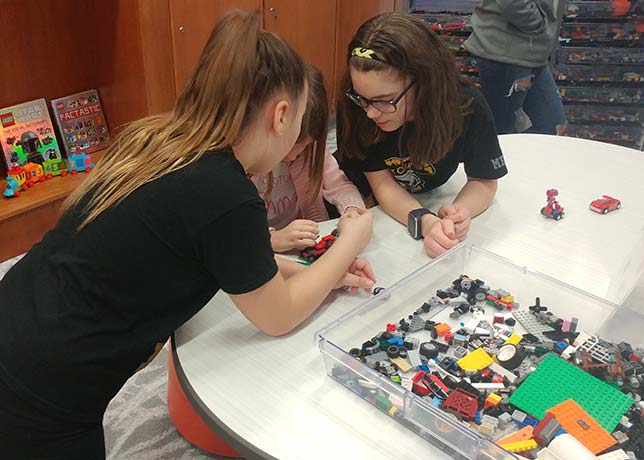
Montour Elementary students collaborate on designing and building cars, which they will then race down a custom track built by Montour High School students. That's just one set of hands-on activities in Montour Elementary's new Brick Makerspace, which formally opened Feb. 22. Montour Elementary students collaborate on designing and building cars, which they will then race down a custom track built by Montour High School students. That's just one set of hands-on activities in Montour Elementary's new Brick Makerspace, which formally opened Feb. 22.


Pennsylvania's Montour Elementary School stands out even among schools that have embraced STEAM education, the maker movement, hands-on learning and augmented and virtual reality. So when the K–4 school opened the world's first "Brick Makerspace" — a Lego Education-powered STEAM lab developed and implemented in conjunction with Carnegie Mellon University, Lego Education, parents, students and a local Barnes and Noble — it wasn't just a one-off affair; rather, it was yet another advance in the school's efforts to integrate principles of STEAM education throughout the curriculum.

 "I believe makerspaces and STEAM education get students interested in learning at a very young age," Jason Burik, co-principal at Montour Elementary, told THE Journal. "STEAM education challenges students to learn and apply content and skills with fun, real-life projects. Skills learned can later then be applied to almost any job. We wanted to create a unique learning space that kids would love coming to, something that no one else had, a room that would inspire students to become architects, engineers, designers, makers, and use problem-solving and critical thinking skills. We wanted a room that made students curious to learn and discover amazing things along the way."

The space, which formally opened with a ribbon-cutting ceremony held Feb. 22, is themed on Lego bricks, with activities ranging from brick building to 3D printing to car racing to stop-motion animation to an interactive mixed reality system that lets students build structures and test their physical properties. Lego Education's WeDo 2.0, Lego MINDSTORMS Education EV3 and Lego Education Simple and Powered Machines are some of the tools employed in the space, along with the new Lego Education Maker activities.


Read the full article at its source: https://thejournal.com/articles/2018/02/26/the-steam-powered-elementary-school.aspx

Click on book cover for information

Click on book cover for information
Getting Started with LEGO Robotics. Anyone who works with kids can do LEGO Robotics, a rich and highly motivating platform for important STEM Learning! (surprisingly affordable, too) This books explains it all!

Robobo: Phone-Driven Robtics for Students

From this morning's In Box... a clever approach to Student Robotics!

Robobo is the next generation of educational robot. We have developed a mobile base that can hold a Smartphone, allowing to use state-of-the-art technology to carry out autonomous robotics projects in the classroom or at home. We have also developed a series of applications that allow you to program Robobo easily from any computer, and thus use all this technology. Read on for more details on the Robobo project.

Robotics

Robobo creators come from research and university teaching in autonomous robotics. Our experience has allowed us to develop this new concept of educational robot focused on a fundamental idea: the robots that are currently used in robotics teaching are technologically limited, which separate them from being useful for a realistic practical learning. In addition, they get outdated very soon, requiring a continuous reinvestment. With Robobo, this problem disappears, because the smartphone always contains the latest technology, so if one becomes obsolete, it is enough to replace it with another one with greater capabilities. The Robobo base and the applications to program it will keep on working, which turns Robobo into a long-term educational tool.

Education

The real goal of the Robobo Project is to advance in autonomous robotics learning. Thanks to the Smartphone's technology, with Robobo it is possible to use advanced capabilities such as vision, sound recognition, speech production, tactile interaction, etc. But autonomous robotics learning requires of suitable didactic material. For this reason, one of the main developments within the Robobo Project has been the creation of learning guides and teaching units, both for the teacher and the student, all made by university professors with extensive experience in robotics. For more information about the Robobo educational curriculum, you can access our website at the following link.
+ EDUCATIONAL ROBOTICS

Saturday, February 24, 2018

From CES 2018 - Student Robots and STEM Resources

STUDENT STEM things... from the Consumer Electronics Show 2018


And below, a very nice piece sent by TechTerra... 

CES 2018 – TechTerra’s Takeaway

CES 2018 was a colossal event. And as exciting as promised. Over 180,000 attendees and over 4,000 vendors made for the show of the year. Our team spent hours exploring new edtech tools. From the 100% autonomous shuttle, pictured above, to Scrabble-playing robots to new coding tools to virtual and augmented reality and so much more, it was mind-opening as always to see and handle the new products and to talk with the developers.
Big picture

Our take-away from the show is that companies are getting better at figuring out how their tools can fit student needs for STEM. Block-based code was popping up across learning kits. Makeblock is using another popular code, flow programming with their new Neuron Kit, electronic programmable blocks. The Robotis humanoid robot allows students to 3D print robotic limbs and code for authentic STEM learning.
FROM the Recent Consumer Electronics Show....

AI and machine learning had the greatest presence across the event. The award winning tool, the best of STEM winner, went to the companion dog. We see this technology becoming mainstream in schools through robots and devices collecting information and then learning and responding like human beings. All of our daily lives will soon be impacted by AI and machine learning. Educators need to be ready for the impact.


See the original piece at its source:
https://www.smore.com/c648y-news-from-techterra-education

Friday, January 26, 2018

Robotics AND Visual Art for Students: ORIGAMI ANIMALS

I found this item in my email in-box; sent to me by Sphero Edu...

Nice idea!!!... and to complete it, I've included some extra items below the video and text:
"Origami is a Japanese word meaning "fold paper." This program shows you how to mount animal origami creations on top of a Sphero and then play an animation that brings the animal to life. We've made three animations for you already: a bird, a whale, and a frog. In this program, we gave you the "animal" variable that lets you pick which animal you want to play. You can add more animals to the mix the same way, just don't forget to increment your animal numbers or you'll be trying to make whales move like cats... which is either weird or awesome. Fold away! #ThursdayLearnDay"

(See the above at its source:
https://edu.sphero.com/remixes/1639441/?utm_source=Sailthru&utm_medium=email&utm_campaign=TDLD-Animal-Oragami-Refresh&utm_term=Education )

Easy Origami Crane Instructions:
https://www.thespruce.com/easy-origami-crane-instructions-4082282 

Origami Frog:
http://www.origami-instructions.com/origami-frog.html

How to fold a very simple Origami Whale


Be sure to encourage and challenge your kids to inject some personal thought and creativity into their origami animal creations... a) how might they change the shape? b) what might they draw or paint or paste onto their origami animal to make it their own? c) what sort of paper might they find with which to fold their animal from that would make it their own, unique creation? ETC!

Extension 1: Have your students give their origami animal a name... write a story about it... etc.

Extension 2: Begin this activity with a bit of cultural learning. Have your students read or view some background info about Origami, its origins, and its cultural fit and significance. Ask THEM to explain it briefly in a group discussion, ETC! Below are just 2 of the thousands of items that explain Origami to be found on the web... why not search for some that would be 'just right' for the group of kids you work with?


Monday, January 22, 2018

FIRST Power Up / 2018 FIRST Robotics Competition

I came across this video through a link on the website of 2Train Robotics, an FRC (FIRST Robotics Competition) oriented robotics team, from New York City's Morris High School Campus in Morrisania (Bronx) and Columbia Secondary School in Harlem. https://www.2train395.com/


This video is one of the ways that FIRST explains the objectives of its annual competition to prospective participant teams. If you are unfamiliar with robotics competitions (a sport of the mind) as a powerful STEM learning activity, this is a great place to start an eye-opening understanding.

Click on book cover for information

Click on book cover for information
Getting Started with LEGO Robotics. Anyone who works with kids can do LEGO Robotics, a rich and highly motivating platform for important STEM Learning! (surprisingly affordable, too) This books explains it all!

Tuesday, December 19, 2017

Robotics Competition Jump Starts Student Creativity

Good piece from Jewish Journal

"Robotics Competition Kicks Student’s Creativity Into Gear"

 
https://youtu.be/IMuE4PKosys

"Participants from 88 countries take part in FIRST Lego League (FLL) regional tournaments around the globe — presenting functional robots and comprehensive research on real-world issues such as food safety, recycling and renewable energy.


And thousands of those competitors and their mentors — from at least 52 of those countries — rely on the online resources created by Jared Hasen-Klein, an 18-year-old senior at Milken Community Schools, to prepare.


“I just created stuff that didn’t exist for me,” said Hasen-Klein, who began competing in FLL as a 9-year-old. “It’s really cool to see all of the countries on a map when I look at my analytics.”


Hasen-Klein said he created his website, hub.jaredhk.com, in 2015 to serve an important need for competitors in the distinguished science and robotics program dreamed up by the toymaker Lego and the nonprofit For Inspiration and Recognition of Science and Technology (FIRST). Together, they’ve held more than 1,400 competitions since 1998 for kids ages 9 to 14.

The problem: a lack of resources made available online for competitors to help with understanding the rules and improving performance. Hasen-Klein’s site not only features the rules — which often take too long to be updated on the competition’s website, he said — but offers games to test knowledge of the rules, printable resources like scoring sheets that teams can use during practice sessions, and scoring calculators.

There’s even an online form that competition referees started using on their phones to transfer scores electronically rather than using pen and paper and running notes over to scoring panels.


On a recent weekend, Hasen-Klein even hosted an all-day workshop at Milken for 65 visiting students and teachers taking part in local FLL regional tournaments to provide an overview of the judging process and answer questions.


“What really sets Jared apart is his initiative to go a step further and offer help wherever it’s needed,” said Stephen Shapiro, Hasen-Klein’s robotics manager at Milken.


Wendy Ordower, Milken’s director of service learning, said Hasen-Klein is prone to this type of selfless donation of his time. He volunteered as a digital expert giving whatever spare time he had to Milken’s school paper, The Roar, for two years before eventually writing for them.


“He does all of this because he just says it’s fun,” she said.


No one pays Hasen-Klein to provide these FLL resources, including the constant updates he makes to his website in advance of regional tournaments that take place each November. Still, he shrugged off the notion that he goes above and beyond.


“I’ve made it a priority to do this stuff. It’s rewarding knowing that people are using my resources. If I’m able to do it, why shouldn’t I do it?” he said.


As a fifth-grader at Abraham Joshua Heschel Day School in Northridge, Hasen-Klein stumbled upon his school’s robotics team when he realized sports and after-school acting programs weren’t for him.


“One of FIRST’s slogans is that robotics is the varsity sport where anyone can go pro. It’s so fun and it shows kids that maybe don’t necessarily fit in somewhere that there’s something for them,” he said. “You don’t have to come in with natural talent. You can learn it. It’s fair to say that was me.”


Now, besides competing in the FIRST Robotics Competition (FRC), also operated by FIRST, for high school students with his Milken team, he co-coaches the Heschel team he first captained seven years ago. He also volunteers as a judge at competitions on many fall and winter weekends, including the FLL world championships, where he meets kids who use his site.


“When I attend the world championship, I walk around to the pit areas and do ‘market research,’ and it is always fun to hear from the teams that found my website,” he said.


Hasen-Klein’s expansive involvement with robotics has earned him several awards, including the Los Angeles Area Volunteer of the Year Award given to him by FIRST at last year’s FRC world championship in Houston.


Kathy Reynolds, who was Hasen-Klein’s first robotics coach at Heschel and now coaches with him there, gushed over her former pupil-turned-colleague.


“We are very proud of Jared for the gifts he brings to these organizations in the enormity of invested time, his generosity in sharing his expertise, and mostly his humble dedication as a role model,” she said.


One of the things Hasen-Klein finds most rewarding about helping kids prepare for FLL competitions is the potential impact he is having on kids passionate about science, technology, engineering and mathematics (STEM). FLL boasts on its website that its worldwide competitions essentially are producing “tomorrow’s innovators.” Hasen-Klein sees something similar at competitions he attends where youngsters tackle real-world issues.


“Being a judge at these competitions has been so cool. When you see the global innovations they are coming up with, it’s amazing and you wonder when they will be adopted by professionals. One that stuck out was do-it-yourself water filters for people in Third World countries or those affected by natural disasters,” he said. “These kids are getting real skills to go get STEM jobs in the future. It’s such a great starting point.”
As for his potential future in the STEM world, Hasen-Klein was mum.


“I still have no idea what I want to do,” he said. “I guess I’ll figure it out eventually.”


Read the article at its source: http://jewishjournal.com/culture/lifestyle/education/228665/robotics-competition-kicks-students-creativity-gear/  

Click on book cover for information

Click on book cover for information
Getting Started with LEGO Robotics. Anyone who works with kids can do LEGO Robotics, a rich and highly motivating platform for important STEM Learning! (surprisingly affordable, too) This books explains it all!