Sunday, November 10, 2019

I like this example of Authentic, Project-Based, Student Robotics Learning: from makeblock


For those who, like me, find wonderful opportunities for Project Based/Authentic Learning with Robotics, here's an interesting program from MakeBlook (appeared in my email In Box this morning)...


"We would like to announce that the final round for mTiny Coding Camp has begun!
Previously, we’ve selected 10 schools to create videos on students playing with mTiny. Start from today untill 28th Nov, you can share the school videos with your communities and others, invite them to vote for you. Don’t forget, the 3 schools with the most votes will receive 5 mTiny units for each school..."


Vote Now
 

After registering (FREE) I was taken by link to a page of videos apparently sent in by schools... the videos show kids working with the robots. I think schools documenting and sharing their learning activities this way is a first step toward Education's next level future... Also, great to see groups of kids collaboratively working with robots and doing real things with them confidently at such an early age. I find this initiative inspiring...

Mark

Friday, November 8, 2019

Great Advice on STEAM Instruction from LEGO Education

Nice piece from LEGO Education
https://www.eschoolnews.com/2019/11/06/5-ways-to-celebrate-national-steam-day/?all

"5 ways to celebrate National STEAM Day"


"Most children entering kindergarten will have jobs that don’t currently exist, and studies also show that most of these jobs will require STEAM skills.


This evolving landscape means STEAM learning is important every day of the year, but on November 8, we get to celebrate National STEAM Day and the critical role it plays in preparing children for the future workforce with the 21st century skills they need.
Related content: How our school transitioned from STEM to STEAM
LEGO Education put together a few ideas to help you plan your celebration. Here are some ways you can help get your kids excited about STEAM:


1. Get hands-on: A recent survey shows that parents and teachers agree hands-on learning is the No. 1 way to build confidence in STEAM subjects. Trade in the worksheets for hands-on activities. There are hundreds of free lesson plans to choose from – or create your own.


2. Try, fail, and try again: When kids face a roadblock, it’s natural to want to jump in and find a solution. Instead, make it a point to let your students try it for themselves first, which helps them develop real-world skills like problem solving and resilience. This will help ready your students for a future career in STEAM.


3. Find what sparks their interest: Ask questions and see what your students get excited to talk about. Switch roles for the day and empower them to be your teacher. Not only will it help reinforce the subject matter, but also boost their confidence by being an expert in something that interests them.
4. Make it into a project: Ask the age-old question, “What do you want to be when you grow up?”

Use National STEAM Day as an opportunity to explore STEAM careers – it might not be what they (or you) expect! Have your students research a STEAM career and share what they learn with the class. They can look up job descriptions or find examples of companies in that field. Here are a few careers to explore: app developer, forensic psychologist, graphic designer, architect, astrophysicist, medical illustrator, civil engineer, archaeologist, product designer, sports announcer and many more.


5. Host a STEAM career day: Reach out to people in your community who are in STEAM careers
to participate in a career day at your school. Or set up a video chat with professionals in your area to share their experiences with your class. Meeting people in these careers helps kids see the connection between what they’re learning in school and the real world.
Share your own ideas and plans using #NationalSTEAMDay #LEGOconfidence.,,"

Read the full article at its source: https://www.eschoolnews.com/2019/11/06/5-ways-to-celebrate-national-steam-day/2/

Tuesday, November 5, 2019

TED-Ed Lessons to introduce students to robotics

A worthwhile idea from eSchool News.... https://www.eschoolnews.com/2019/10/14/5-ted-ed-lessons-to-introduce-students-to-robotics/?ps=markgura%40verizon.net-0010c00002Afygh-0030c00002sNJwe&esmc=195464 

"5 TED-Ed Lessons to introduce students to robotics..."

"... TED-Ed Lessons offer a video library and the chance to build and customize robotics lessons for students

Robotics is gaining popularity in classrooms across the country, moving from an old sci-fi concept to a way to engage students in STEM learning by solving real-world problems.
One of the hurdles, though, is in finding the right resources to introduce robotics. Sometimes, it all starts with a video and a simple lesson. You can find a variety of robotics-related videos on TED-Ed Lessons.


The TED-Ed platform is especially cool because educators can build lessons around any TED-Ed Original, TED Talk, or YouTube video. Once you find the video you want to use, you can use the TED-Ed Lessons editor to add questions, discussion prompts, and additional resources.


Related content: Off-the-wall TED-Ed Lessons for your classroom
Here are 5 robotics videos and lessons to get you started in your classroom:
5 cool TED-Ed Lessons on robotics and STE

Years Later, CEO Reunites With His High School Robotics Team


Seventeen Years Later, CEO Reunites With 2Train Robotics
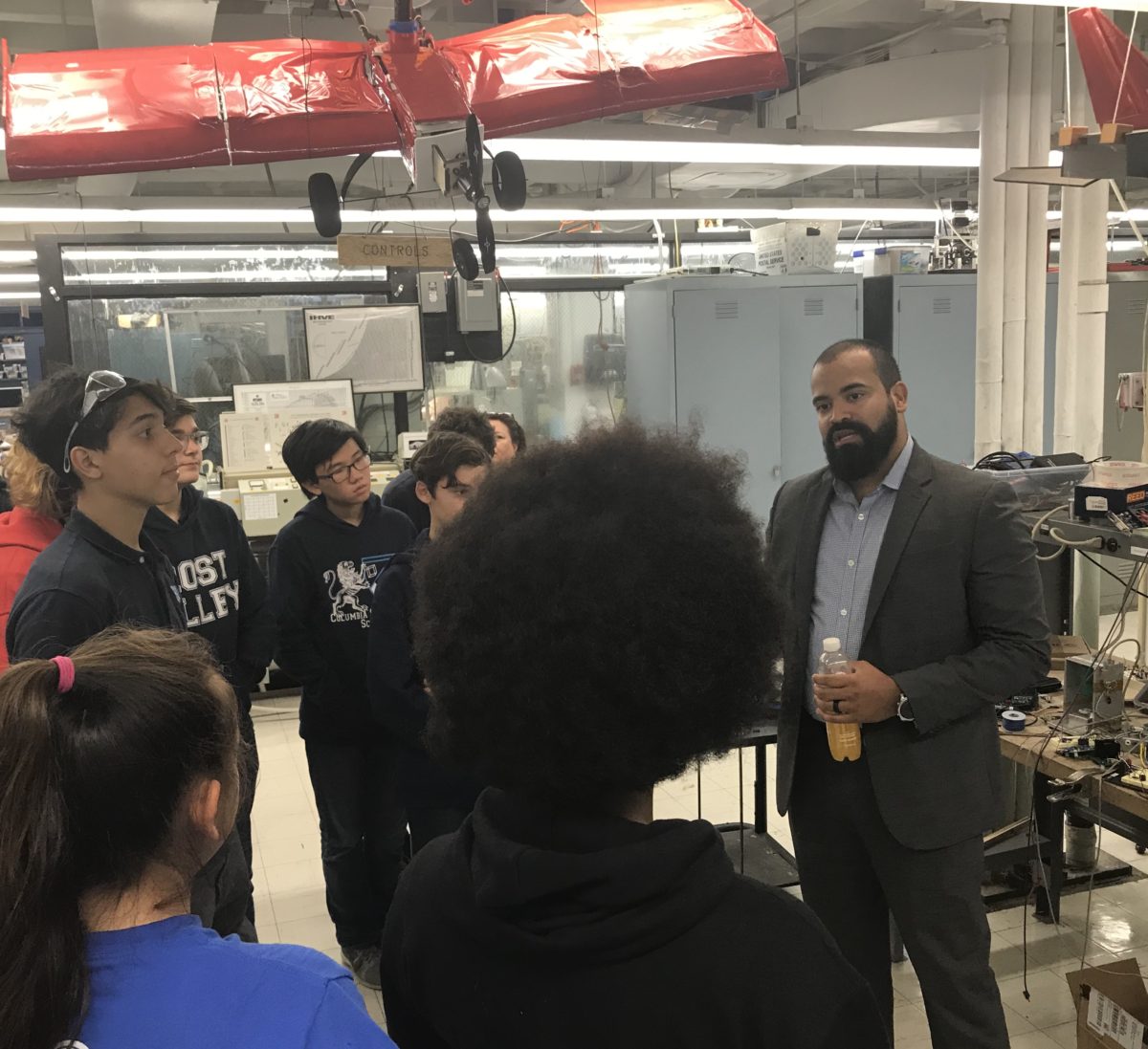
Carlos Martinez talking to current 2Train members about his past experience. (Photo by ThisistheBronX).

by Alonso Espinoza
November 5, 2019
As they launched their 21st season, the 2Train Robotics Team that originated at Morris HS and has blossomed into a full-fledged educational institution, welcomed back a former student who has gone on to an important career as a CEO who impacts the lives or others.

Last Monday, former member Carlos Martinez returned to Columbia University to join a team meeting for the first time since 2002. He spoke in front of current members of the team, sharing his experiences and the incredible impact 2Train had on his life. 

“2Train was a big influence on me with teamwork and awareness,” said Martinez who grew up in Hunts Point. “It’s great to come together for one objective and the program allows you to experience things outside of your small bubble in the Bronx.”


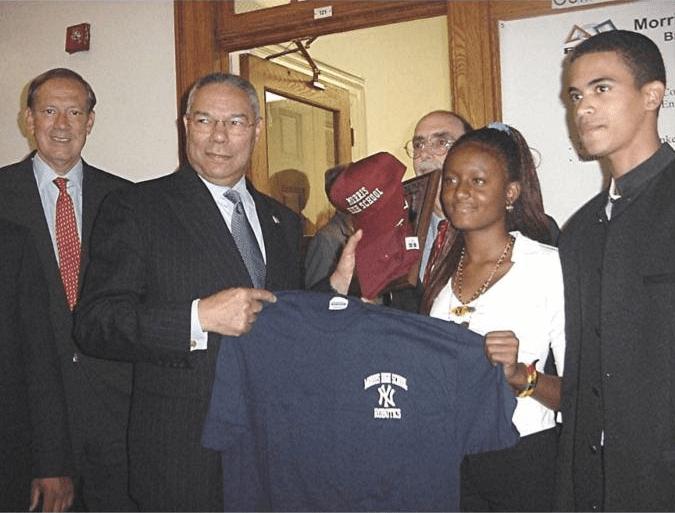
In 2002, he was a part of the first team that was honored on Yankee Stadium field for their success (they’ve been honored numerous times since), he met Secretary of State Colin Powell who was also a Morris HS student, and participated in the first 2Train out of state competition in Florida at the Kennedy Space Center.
Carlos Martinez (far right) meeting Secretary of State Colin Powell in 2002. (Photo courtesy of Gary Israel).
Over the 17 years Martinez drifted away from pursuing engineering as a career, but he is making significant impact as the CEO of Rockland County’s Independent Living Center’s (BRIDGES). BRIDGES is a non-profit agency dedicated to advocating and providing support services to improve the quality of life for people with disabilities. He says the lessons he learned during his experiences with 2Train still resonate with his work at BRIDGES.

“The teamwork and awareness combined with the experience and skills i learned at 2Train, have enabled be to be where I am today,” he said. “These have impacted my ability to do my job directly.”

Martinez is a Licensed Master Social Worker (LMSW) with more than a decade of experience and he joined BRIDGES in 2010 where he served as an assistant director of Personal Assistance Self-directed Employer of Rockland (PASER) program.

When Martinez joined this year’s team meeting, the founder of 2Train, Gary Israel couldn’t help but reminisce about the legendary 2002 team. He says that connecting with former students and listening to how the team has impacted their lives is priceless.
“I could not be more proud of Carlos and what he has achieved,” Israel said. The icing on the cake was when Carlos spoke to the current members on the team. How inspiring for them to hear his story of success,” Israel said.
Currently in their 21st season, 2Train has continued to grow as a program. Despite that fact that the program runs through Morris High School, Columbia Secondary School, and Inwood Early College, 2Train is one of the only robotics teams in the Bronx that allows kids to join even if they don’t attend those schools. Israel calls it his “open-door” policy, that accepts any youngster who wants to learn. It was established last winter.

Last spring they launched their 20th season with an exciting victory. Despite losing seven seniors from that group, Israel is excited to continue with the younger group that he has now. 2Train is set to take the competitive stage on Saturday, Nov. 9th in New Jersey where they will showcase their “Starship” robot.

Sunday, November 3, 2019

Artie 3000™ Coding and Drawing Robot... a bit of a review...

I came across this one on Facebook... and as an educator who specializes in Student Robotics, Student Creativty, and Art Education this naturally caught my attention...


ART-BOTS have been around a long time. I included some stuff on them in my book for ISTE (International Socieity for Technology in Education) "Getting Started with LEGO Robotics: An Educators Guide"... those were drawing robots that kids created and constructed with the LEGO Robotics Kits... and that's quite a project. But this is something related but different. This one appears to be a pre-built robot whose function is to draw... kids (or adults) create works of art by programming the robot to draw it as it travels around. Again, not a new idea, there were LOGO (programming language) Turtle Robots drawing for kids who programmed them years and years ago.

BUT the ARTIE 3000 Coding and Drawing Robot seems to me to be a low cost, robust student robot that does all of this well and that should give kids in classrooms (or elsewhere) very good STEAM learning experiences with much of the prep and problems taken out of it... In other words IF you want kids to get down to coding a robot and making art with it (and there is a rich, rich vein of learning to be mined through this approach), this seems to be a good approach!


As for the Visual Art aspect of this... Well, kids won't develop the motor skills involved painstakingly learning to draw with a simple implement like a pencil (I taught middle school drawing for many years, by the way)... BUT, that TOO could be the point because Artie 3000 promises to draw shapes (and patterns, etc) that appear visually perfect, thus taking the frustration factor (a high one) out of the art activity.

What sort of artistic image  might a kid make with this? Well, the kid has to learn how to program the robot to draw what he or she wants (trust me, the coding/programing approaches that would be used ARE simple and will lead to a good understanding how programming works... and by extension, how humans get their intelligent machines to do their work for them).

Could kids make great art with Artie? Why not? And by the way, the robot isn't making the "Art", simply making the marks on the paper... the ideas, explorations, art works... are the kids... And as is the case with any other 'Art Tool' Artie is a means and not an end... and thus, kids will still benefit from learning discipline and perseverance (grit) and in learning what is Art and the elements of design that go into it, etc... The kinds of things that a good art teacher would teach.

Caution, while I do think that this would make a great addition for any classroom (could be a single unit placed as a learning station somewhere in the classroom). This will not take the place of a full Technology/Student Robotics program and will not take the place of an Art Program (although this would make a nice addtiion to one and, as a bonus, make for a great way to understand STEAM, the intersection of STEM with the Arts)... You go, Artie 3000!


As it appeared this morning in Amazon...

Educational Insights Artie 3000 The Coding Robot: STEM Toy, Coding Robot for Kids 7+

Amazon's Choice for "mensa for kids"

List Price: $69.99
Price: $62.99 FREE One-Day & FREE Returns

Friday, November 1, 2019

Robotics and Hands-on Learning Improve Middle-School Confidence

Good article from smartbrief.com
"How hands-on learning improves middle-school confidence"


Aaron Maurer
"...the endangered species at the core of this workshop is the engaged student."
“Saving the Endangered Species.” That’s the name of a full-day workshop I’ve been leading with educators.


I’m not a biologist, however. I’m an educator. And the endangered species at the core of this workshop is the engaged student. How do we find, rescue and cultivate engaged students today, especially at the middle school and high school levels where so many kids check out?


As students come up through the school system and start to approach middle school, we tend to frontload their classroom experience with pressure. Take these notes. Read this chapter. Take this test.


There is pressure coming at them from other angles too. These are the years when students are going through a lot of change — changes in schedule, changes in their bodies, changes in their friends and social groups.


It’s a time when their vulnerability is high, and the effects of a perceived failure in an activity can take on magnified meaning. I often hear kids say, “I’m not good at music.” Or math. Or basketball. They start to self-select out of subjects and programs. Their confidence at this age can be fragile.
This is especially true with subjects that have a reputation for being “hard,” including math and engineering. A recent survey from Harris Interactive in partnership with LEGO Education found that just one in five kids said they feel “very confident” when it comes to STEAM subjects.


Raising confidence in STEAM can be especially difficult because if a student fails a math test, they tend to conclude they are just innately bad at math. Their confidence wavers, and if they experience disapproval of that failure from peers or parents, they may try to avoid the subject entirely, fearing the risk of repeating those experiences. The same survey revealed that 47% of students say they avoid subjects where they have failed before.


There’s another big change that happens in education once we hit middle school, and I don’t think it’s a coincidence. Schools start to slide away from hands-on learning right around third grade, when standardized testing begins to take hold in the mindset of educators and schools. Most critically, you see this shift at that sensitive middle school level. With so much going on at this stage of learning, we must find a way to keep that physical, tactile, experiential learning space and culture going at the secondary level.


Hands-on learning — learning through building, through trial and error, through collaboration — has the power to engage kids in a way that lectures and worksheets simply don’t. Getting hands-on with a challenge or a task allows them to explore and realize there isn’t just one answer. It allows them to experience failure in a healthy way and realize that failing at a task is a natural part of the learning process and does not mean a subject is out of their reach.


Then there’s that all-important sense of accomplishment. It’s a rush when you build a robot and it moves for the first time. When something doesn’t work and kids have the opportunity to troubleshoot and make it work, you can see their confidence light up.


In my teaching days, I gravitated toward solutions that allowed my middle school students the freedom to build and create on their own, and that’s the direction I point administrators and teachers today. Although there are many out-of-the-box projects available, I advise teachers who themselves are often building confidence in STEAM subjects to find ones that let students come up with their own ideas.


How to go about bringing hands-on learning into the classroom is a question every district and school has to decide for themselves. It all starts with your learning space and the culture you’ve created. The same research found that 95% of teachers believe that hands-on builds confidence, yet 4 in 10 say it’s not typical at their schools.


It truly is amazing what can happen if you just give kids a challenge or a good prompt and allow them to take their own ideas and put them into practice. The struggle can be just as valuable as the success. By getting hands-on in middle school and beyond, we can start to move away from some of the pressure that’s causing confidence and engagement to decline today, and infuse learning with a state of wonder, trial and error, and challenge and solution..."

Read the full article at its source: https://www.smartbrief.com/original/2019/10/how-hands-learning-improves-middle-school-confidence?utm_source=brief&utm_medium=FeaturedContent&utm_campaign=EducationOriginals